
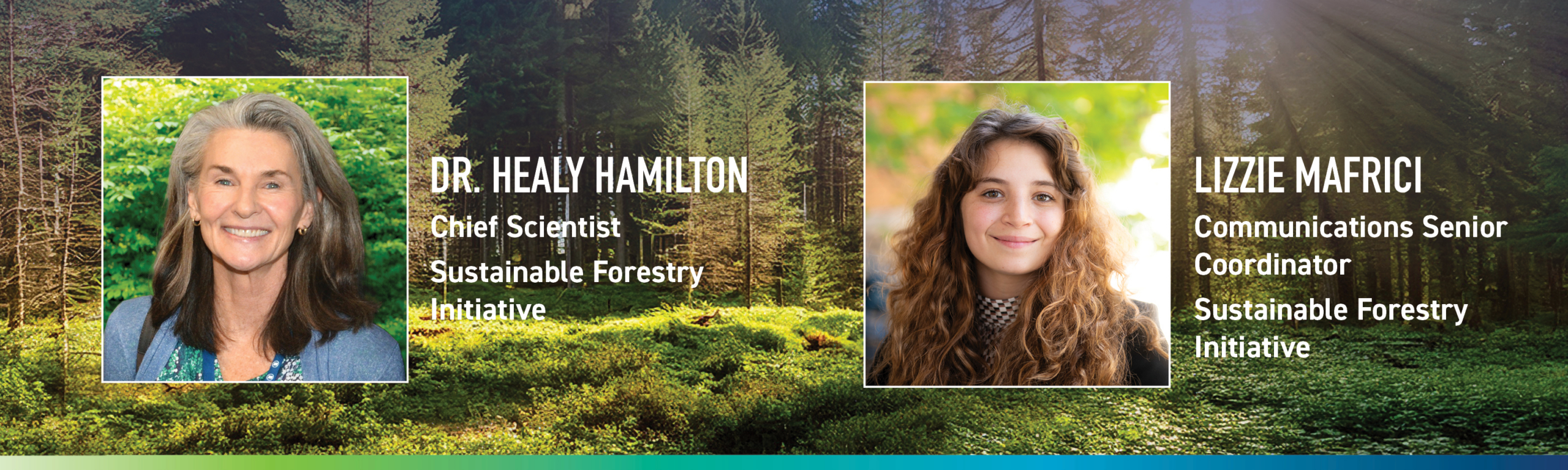
Lizzie Mafrici, Communications Senior Coordinator at SFI, sat down with Chief Scientist Dr. Healy Hamilton ahead of her trip to the 17th Conference of the Parties to the UN Convention on Biological Diversity (CBD COP17) in Yerevan, Armenia.
The two discussed the importance of biodiversity, the role of forest certification, and how sustainability frameworks align with certification systems and the forestry sector.
Why are businesses becoming more engaged in biodiversity conversations?
Healy:
We are seeing dramatic increases in interest in the topic of biodiversity across many different sectors, driven not only by customers seeking sustainability assurances, but also by investors, banks, and creditors seeking to understand and manage nature-related risks to their investments.
Forestry is dependent on nature, and our investments are focused on the long term. Many SFI-certified organizations, especially those that are publicly traded, are getting a lot of questions from the investment community about the status and trends of biodiversity on the certified forest lands they manage.
As a result, businesses are increasingly working to measure and disclose their impacts and dependencies on the natural world, so that investors can make informed decisions about biodiversity risk and opportunity.
I noticed that when reading through Annual Sustainability Reports from SFI-certified organizations. Many are looking to sustainability frameworks as a way to communicate their sustainability and biodiversity goals to customers, employees, and investors. Can you walk me through some of these frameworks and the kinds of information they’re asking for?
Healy:
There is a whole alphabet soup of frameworks that has emerged for reporting on nature-related financial disclosures, such as the Task Force on Nature-Related Financial Disclosures (TNFD), the Science Based Targets Initiative (SBTI), and the Nature Positive Initiative (NPI).
Many of the core metrics across these frameworks are readily quantifiable, such as chemical use, pollutants, and water resource use. Far more challenging to measure, though, is the ecological condition and trends of species and ecosystems, yet these get at the very core of investors’ concerns. Declines in these indicators are what raised alarm bells in the first place.
Through NPI’s leadership, all of them are converging on a similar set of state-of-nature metrics, and we anticipate that many SFI-certified organizations will be working to report on these metrics. They involve information about species extinction risk, the ecological condition of the landscape, and the ecological condition of particular sites – all of these are metrics that also relate to the conservation objectives of SFI certification.
It must be challenging to measure and report on a topic as broad as species and ecosystems?
Healy:
There are many challenges in developing methods for measuring and reporting on biodiversity. Which species do you measure? How do you determine what is ‘good’ for ecosystem condition? Where do you get the data you need?
The data question is particularly hard: biodiversity data is incomplete, hard to access, nuanced, and takes expertise to know how to analyze it.
SFI is working to help certified organizations navigate this process. We recently released a Sustainability Framework Crosswalk Tool that maps specific SFI objectives, indicators, and requirements to corresponding elements across multiple frameworks, showing how SFI Standard requirements align with these frameworks.
Another example is the soon-to-be launched SFI Conservation Values Viewer, which will allow certified organizations to easily evaluate the presence/absence of a suite of conservation values at parcel and landscape scales. The SFI GIS team worked with biodiversity science leader NatureServe – the most complete and authoritative source of biodiversity info in North America – to curate and visualize a suite of indicators that are relevant to SFI Standards and the State of Nature metrics.
Can you tell me more about the State of Nature metrics?
Healy:
These metrics are both the core of what is most needed to understand business impacts on the natural world, and they are the hardest to measure. They’re not like carbon disclosures. We know how to measure our carbon use. But how do you measure the state of nature?
Nature encompasses species, populations, genetic diversity, and the overall ecological integrity of ecosystems. It’s complicated!
Over the last several years, the Nature Positive Initiative has led a collaborative, science-based effort to determine what types of metrics are meaningful and feasible. Earlier this year, TNFD, GRI, and SBTI stated they would adopt the NPI metrics. And this conference will see the release of the final metrics, which will focus on measuring species’ extinction risk, ecosystem condition and extent, and site and landscape scales.
As organizations work to meet these evolving expectations around biodiversity reporting, where does forest certification fit into the picture?
Healy:
Both the SFI 2022 Fiber Sourcing Standard and the SFI 2022 Forest Management Standard include multiple objectives focused on the conservation of biodiversity. We have performance measures and indicators that address species and ecosystems at site and landscape scales, aligning closely with many of the metrics included in nature reporting frameworks.
For investors and customers, SFI certification already provides many of the assurances about nature that they are seeking. For SFI-certified organizations, this alignment means they are well positioned to respond to nature-related disclosure frameworks because SFI certification provides such a strong foundation for these assurances.
We’ve discussed how SFI certification helps organizations manage biodiversity and respond to evolving disclosure frameworks. Looking more broadly, how can SFI-certified forests contribute to global biodiversity goals?
Healy:
Over the last several decades, forest certification has driven measurable improvements in how we manage forests for their multiple values: not only for timber and pulp and paper products, but also for the protection of water resources, biodiversity conservation, carbon management, and the social benefits forests provide.
When we then consider the scale at which SFI-certification has been adopted, we can begin to understand the significance of our global impact: more than 350 million acres (150 million hectares) across the U.S. and Canada.
Working forests provide habitat for biodiversity, sequester carbon, maintain healthy aquatic ecosystems, create landscape connectivity, provide social, recreational, and health benefits – and help prevent deforestation.
Why is this year’s CBD COP17 such an important moment for biodiversity conservation?
Healy:
In 2022, all of the signatory nations to the Convention on Biological Diversity signed a commitment called the Kunming-Montreal Global Biodiversity Framework, to achieve a series of conservation targets and goals by 2030.
CBD COP17 is the first global stock take on how countries are doing, individually and collectively, toward meeting these goals
We have to have information about which targets we are on track to meet, and which ones we’re falling short on, so that we can understand how to redouble our efforts in the time remaining between now and 2030.
From reducing threats to biodiversity, to promoting more sustainable resource uses and providing tools and solutions for mainstreaming biodiversity conservation in decision-making, SFI-certified organizations are delivering on the goals and targets of the global biodiversity framework every day.
Can you share a bit about SFI’s presence at the Convention and the events you’ll be participating in?
Healy:
SFI will be very active at this COP! One event I’m especially excited about will bring leaders from all the major global forest certification systems together. SFI has partnered with the Program for the Endorsement of Forest Certification (PEFC), the Forest Stewardship Council (FSC), and the International Sustainable Forestry Coalition (ISFC) for an event highlighting the relevance of forest certification to nature-related disclosure frameworks. It’s a milestone moment to have us all on stage together emphasizing the collective benefits of certification.
I am also very proud to represent Project Learning Tree, in partnership with global mapping software leader Esri, to present Forests, Water, and People. Esri developed Forests to Faucets for the U.S. Forest Service, using geospatial modeling to identify watersheds important for surface drinking water. PLT built on that work to develop an interactive environmental education resource that helps people better understand the role forests play in collecting, cleaning, and delivering our water.
These are just two of the five events SFI is participating in at CBD COP17. Keep an eye on SFI’s LinkedIn channel for more ways to connect with us throughout the conference.


