By Dr. Joe Bowden and Dr. Lucas Brehaut (Adjunct Professors, Memorial University of Newfoundland / Research Scientists, Natural Resources Canada – Canadian Forest Service) and Dr. Healy Hamilton (Chief Scientist, SFI)
Pollinators play a critical role in ecosystems around the world. Pollination, or the transfer of pollen that enables most flowering plants to reproduce, is essential for the majority of the fruits and vegetables we depend on for our agricultural systems. But pollination is just as critical for the health of our forest ecosystems. This makes the well-documented downward trend of global insect populations very concerning, including in northern regions, where climate change may be exacerbating the drivers of pollinator decline.
Many of the plants that pollinators interact with are culturally important to northern forest communities. For example, berry plants (raspberries, wild strawberries, blueberries etc.) are seasonal food sources, and flowering plants form the foundations of a variety of medicines. Some plants are even used for ceremonies and spiritual practices. These plant-pollinator interactions therefore extend beyond simple ecological processes, laying the foundation for food security, cultural continuity, and Traditional Knowledge systems. These forest-based ecosystem services are especially important for rural and remote communities that rely closely on their surrounding environments.
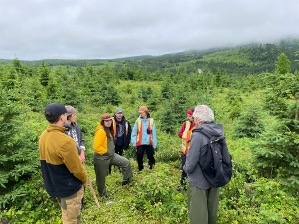
Elder Barnes discusses with students and the researchers various aspects of the forest, values, and the plants within it.
In the beautiful boreal forest of the Island of Newfoundland, a diverse group of partners are working collaboratively to understand the role of managed forests in conserving pollinating bees and other insects. With funding support from the Sustainable Forestry Initiative, research partners from Memorial University of Newfoundland and Labrador and Natural Resources Canada are working with the Qalipu First Nation, and SFI-certified company Corner Brook Pulp and Paper Ltd. (CBPP) in the traditional Mi’kmaq territory to understand pollinator diversity across a range of managed forests. By consciously weaving together traditional knowledge and ‘western’ science approaches, the team is studying plant and pollinator diversity across a chronosequence of harvest, that is, forests of differing ages and therefore different stages of forest regeneration. This project aims to advance ecological understanding of how the biodiversity of plants and pollinators change in response to time-since-harvest, while also focusing on culturally significant plant species to support continued availability in a changing climate.
Project researchers first established the chronosequence in 2023, in collaboration with CBPP, setting up a field study design of replicated sites harvested over differing time intervals (0-5, 10-15, 20-25, and 30-35 year ago). This sampling design is well-suited to address relevant questions of the health of pollinator and understory plant communities, an important focus of the SFI 2022 Standards. CBPP supported this favorable sampling design for the project’s required fieldwork, enabling the collection of meaningful data that will, in turn, contribute insights into the composition and abundance of plants and pollinators across their managed lands.
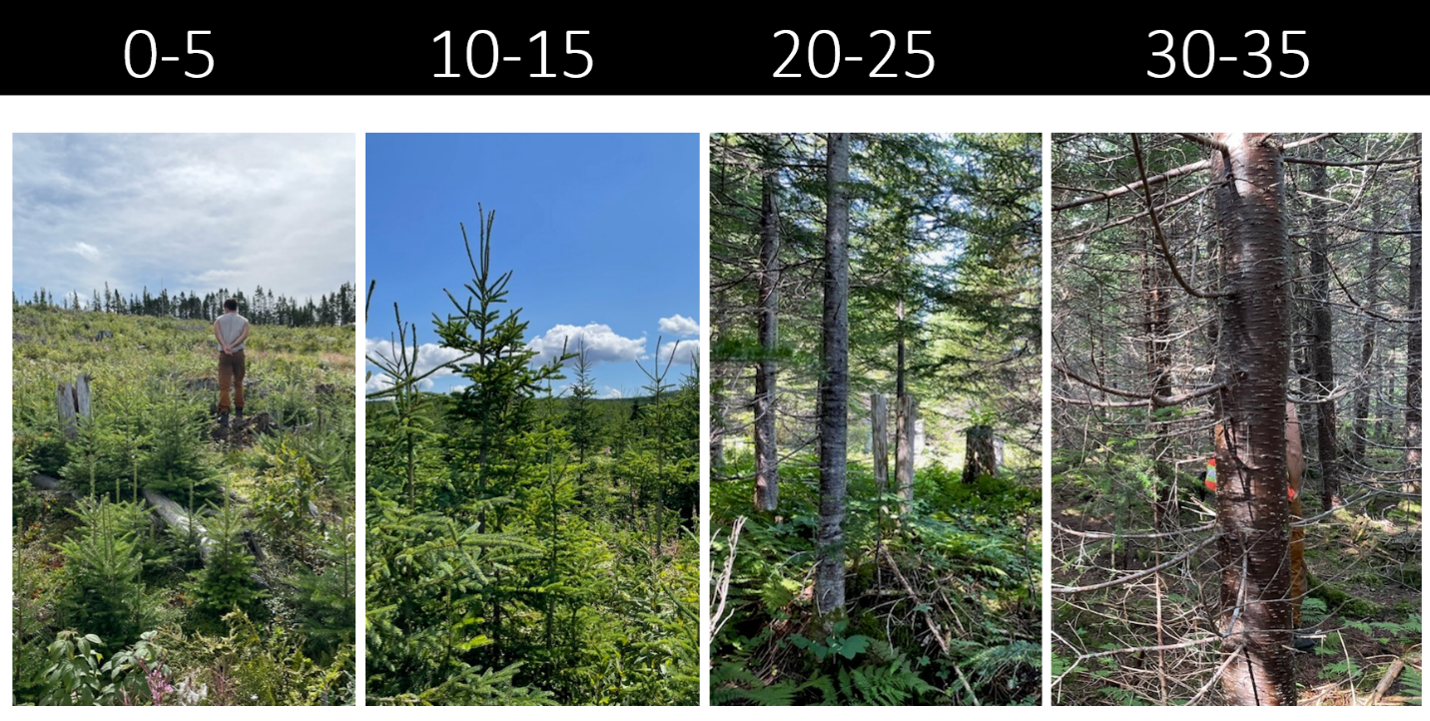
Example sites from the chronosequence of harvest used to study pollinator and plant diversity in the boreal forest of Newfoundland, Canada. We selected replicated sites within stands that had been harvested 0-5, 10-15, 20-25 and 30-35 years prior, providing a time series of forest ages and structures for evaluating harvest effects on pollinators.
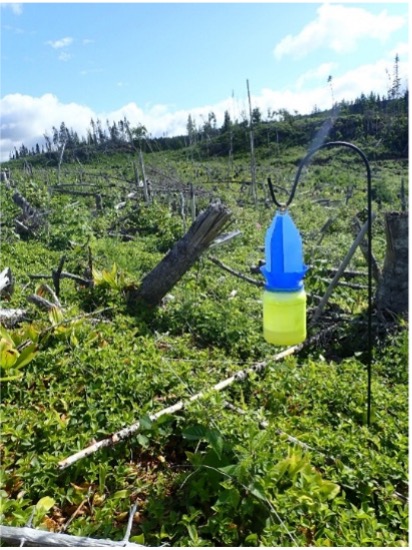
Blue vane insect trap placed in an early succession (0-5 year old) stand.
Using a range of field collection tools and techniques, the last two field seasons have yielded several surprising and important findings. The team collected over 2,000 pollinator specimens, identifying over 50 different species – not just bees, but also pollinating flies. Among them was a notable discovery, a type of hoverfly – the yellow-banded leafwalker (Chalcosyphus anthreas) – that has never been recorded before in the province! Both pollinator abundance and species richness peaked in the younger, more recently harvested forests, demonstrating that early successional stands are a critically important part of the forest mosaic landscape for conserving pollinator species and the ecosystem services they support.
The research team collected additional data that is still being analyzed, including field plot manipulations designed to understand how flowering responds to warmer temperatures, and nearly one million camera trap images capturing insect pollination events from which species identifications will be extracted. Further field studies characterizing the understory communities across this forest chronosequence are currently underway.
Plants and the pollinators that interact with them are not simply background actors in forest ecosystems – they are central to how boreal landscapes function, regenerate, and sustain the species and resources that many communities value most. The research underscores how closely plant-pollinator relationships are intertwined with forest management, climate change, and cultural practices. Continued sharing of lessons learned from this work will encourage other SFI-certified organizations in the region to appreciate, manage for, and conserve these often overlooked yet vital pieces in the mosaic of eastern Canada’s boreal forest ecosystems.